What Is Montessori Education? A Parent’s Guide to How Children Learn
Montessori education is an approach in which children learn through hands-on activities, meaningful choices, and guidance from a trained teacher. Developed by Dr. Maria Montessori, it combines a carefully organized classroom with lessons that respond to each child’s development. Children have room to explore while learning how to care for materials, respect others, and participate in a community.
For a parent exploring preschool options, the most useful question is often: What would my child actually do there?
This guide looks at the Montessori method through everyday classroom experiences, with particular attention to the toddler and preschool years. The American Montessori Society’s introduction to Montessori provides additional background on the approach.
What Does a Montessori Classroom Look Like?
A Montessori classroom is designed to make purposeful activity accessible. Materials are arranged on low shelves, furniture fits the children, and there are places to work individually or with others. Educators call this a “prepared environment.”
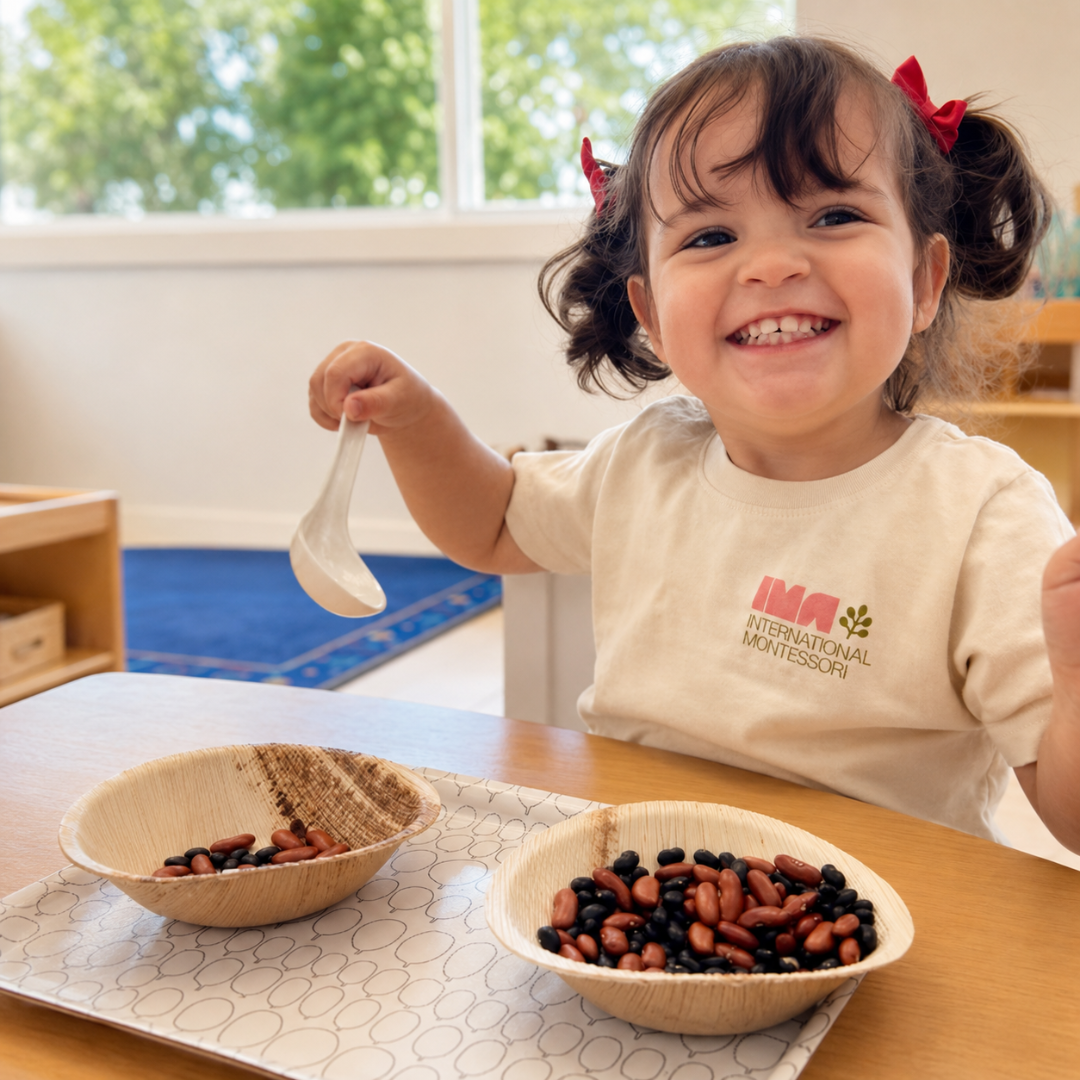
Picture a child choosing a familiar activity, carrying it to a table, using it, and returning it when finished. Each step is part of the experience: making a choice, handling objects carefully, and leaving the activity ready for someone else.
Children also have extended time to revisit activities. The teacher observes and offers lessons rather than requiring everyone to change tasks at the same moment. Trained teachers, mixed-age groups, Montessori materials, child-directed activity, and uninterrupted work periods are the five core components identified by the American Montessori Society.
How Do Children Learn With Montessori Materials?
Montessori introduces many ideas through something a child can see, touch, or move before working with an abstract symbol. A quantity can be handled and counted before it is represented only by a written numeral.
Some materials also make a mismatch visible. A child may notice that a piece does not fit, reconsider the arrangement, and try again. This feature is known as “control of error.” It gives the learner feedback without making every correction depend on an adult.
Repeating an activity offers further practice. The Association Montessori Internationale glossary explains these principles of concrete learning, self-correction, and repetition.
What Do Children Learn in a Montessori Preschool?
The curriculum brings everyday skills together with language, mathematics, sensory exploration, and learning about the world. These examples illustrate common Montessori activities; they are not a record of a particular day at IMA.
Practical Life
Pouring water, fastening clothing, or wiping a table gives children practice with useful sequences of movement. Social lessons include how to ask for help, wait, and treat another person’s activity with care.
Sensorial Exploration
Children compare qualities such as size, shape, color, or texture. For example, arranging the Pink Tower’s cubes invites close attention to differences in size.
Language and Mathematics
Conversation, stories, sound activities, and tactile letters offer different ways to explore language. In mathematics, materials connect quantities with numerals and introduce increasingly complex relationships as children are ready.
Cultural Studies
Learning about plants, animals, places, music, and art opens conversations about the wider world. A leaf or a map can become an invitation to observe, name, compare, and ask questions.
The American Montessori Society’s early childhood overview describes these curriculum areas and their materials.
Does Montessori Mean Children Can Do Whatever They Want?
Children’s choices take place within a community, with guidance and expectations for safety and respect. A child may choose an available activity they know how to use; that freedom does not include taking another child’s materials or using them unsafely.
The teacher remains actively involved: noticing interests, demonstrating a new task, and helping when a child needs direction. Independence develops with support.
For example, a teacher might demonstrate carrying a tray, then offer help with one step as needed. This illustrates the careful demonstrations described in the AMI glossary.
How Does Montessori Differ for a Two-Year-Old and a Five-Year-Old?
For toddlers, learning is closely connected to daily routines. Washing hands, using utensils, naming objects, moving, and joining simple social exchanges are meaningful activities. Adults adapt support to each child’s abilities, as described in the AMS guide to infant and toddler environments.
In a classroom for ages three to six, children encounter a broader sequence of materials and activities. Practical tasks continue alongside developing interests in writing, reading, numbers, and the natural world. The AMI overview of Montessori for ages three to six describes this stage of exploration.
These are broad program descriptions, not deadlines for individual children. When visiting a school, ask how placement decisions are made and how teachers respond when a child needs more practice or a new challenge.
What Should Parents Look for When Comparing Schools?
Use a visit to connect educational ideas with what you can observe. Consider asking:
- How do teachers decide when to introduce a new activity?
- What happens when a child struggles to choose or becomes frustrated?
- How do children practice resolving disagreements?
- How will you share my child’s progress with me?
Ask for specific examples. An explanation of how a teacher supports a hesitant child may tell you more than a broad promise about confidence or school readiness.
Explore Montessori Education at IMA in Miami
International Montessori Academy offers a toddler program for children from 12 months to three years and a preschool program for ages three to six. Explore IMA’s Montessori programs to learn about these age groups.
Our curriculum includes Practical Life, Sensorial, Language, Mathematics, and Cultural Studies. Gardening, Science & STEM, Art, and Music also form part of our educational program and are included in tuition. Our approach to Montessori education explains the values behind that learning environment.
Visit us at 12400 SW 84th Ave Road, Miami, FL 33156. Bring your questions about your child’s interests, daily routines, and transition into school.
Schedule a tour of IMA to see the environment, meet our team, and discuss the next step for your family.